Your Comprehensive Guide to Supplier OnboardingSupplier (or vendor) onboarding is the structured, essential process of collecting and verifying all required data from prospective suppliers to officially incorporate them into your company's purchasing and supply management systems as approved. This initial stage is crucial for establishing a secure and compliant framework that governs all future transactions. The primary objective is to enable key business activities: the efficient and secure acquisition of required goods and services, and the accurate, timely remittance of payments. This process ensures that every new partnership begins on a verified, legally sound, and financially clear footing.
View Supplier Onboarding Templates, Forms and Examples

Why Supplier Onboarding Matters?In business, the relationship between a buyer and a supplier is a critical determining factor of success. It goes far beyond a simple transaction; it's a strategic partnership. Done efficiently, supplier onboarding speeds processes, decreases risk, and sets the groundwork for seamless operations. If this process falls below par, it can lead to compliance failures, quality issues, costly delays, and fractured communication.The purpose of the supplier onboarding process is to ensure that every new partner is compliant, understood, and integrated according to organizational standards. It’s about conducting the necessary due diligence to confirm a supplier is not only capable but also aligns with your company's values and legal requirements. The ultimate goal is to transition a potential partner into an actively contributing asset with speed and confidence. By thoroughly vetting potential suppliers during the initial stages of engagement, businesses can identify any vulnerabilities or weaknesses that could pose future challenges. This proactive approach not only safeguards against disruptions but also builds resilience within the supply network. Essentially effective supplier onboarding transforms what might otherwise be transactional interactions into collaborative relationships supported by trust. Companies seeking long-term growth should view this process as an integral component of their strategic framework—one that lays the foundation for sustainable success in an increasingly competitive market. Supplier Onboarding Workflow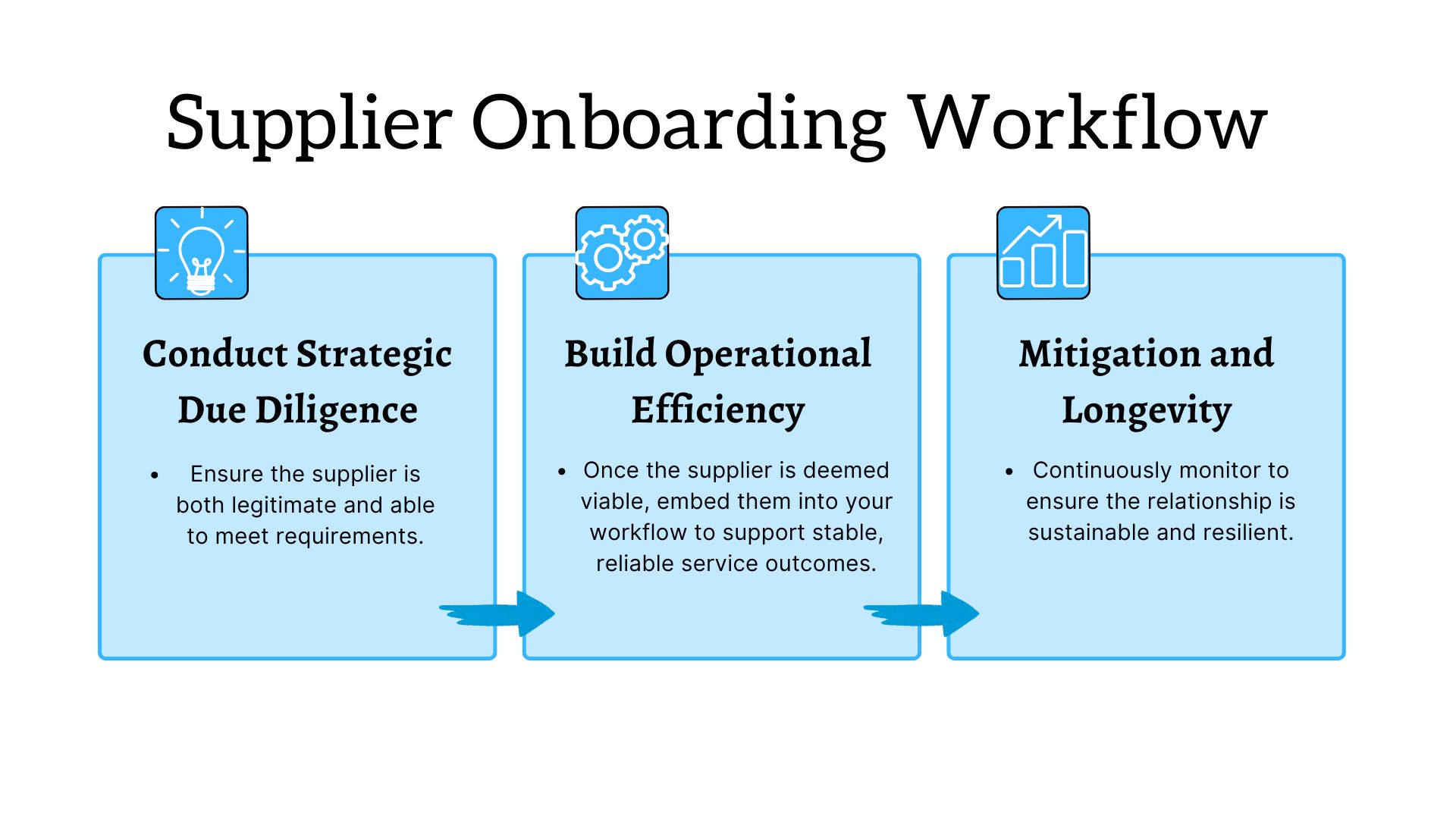
While the specific steps can vary by organization and industry, a comprehensive supplier onboarding process generally includes these key stages: Conducting a Strategic Due Diligence, Building Operational Efficiency and Mitigation and Longevity. 1. Conducting a Strategic Due DiligenceThe first step of supplier onboarding is to conduct thorough due diligence. This ensures the supplier is both legitimate and able to meet requirements. Information to check or collect includes:Capture Company Information: Collect detailed information on the supplier's background, history, capabilities, and industry experience. This profile helps determine if they possess the necessary scale and expertise to meet your needs reliably. This includes requesting organizational charts, facility capacity reports, and client references. Compliance Information: It’s crucial to confirm that every supplier complies with the necessary laws and regulations. Verify documents regarding business licenses, relevant certifications, and insurance coverage (e.g., liability, workers' compensation). Compliance checks mitigate legal exposure and ensure ethical sourcing. Check Quality Assurance (QA): A supplier's quality must matches your company’s standards. Evaluate their quality assurance policies and processes by requesting copies of their Quality Management Certifications standards and certifications and review their internal procedures for defect identification, reporting, and corrective action. This might be done as part of a wider supplier onboarding checklist. 2. Building Operational EfficiencyOnce the supplier is deemed viable, the priority becomes embedding them into your workflow to support stable, reliable service outcomes. Achieving Operational Efficiency includes addressing:Delivery Time and Schedule: Clearly define the expected delivery time frames, logistical requirements, and on-time delivery metrics. Establish a mutually agreed-upon delivery schedule, including contingency plans for potential disruptions. Late deliveries are a leading cause of supply chain failure, making this a critical area. Communication Protocols: Outline how best to communicate with the supplier. This involves identifying key contacts, specifying preferred communication channels (email, dedicated portal, phone), and setting expectations for response times. Clear communication minimizes misunderstandings and speeds up conflict resolution. Reporting and Performance Tracking: Establish a formal reporting system to track the supplier's performance. Define Key Performance Indicators (KPIs) based on your needs (e.g., on-time delivery percentage, quality score, invoicing accuracy) and agree on the frequency and format of these reports. 3. Mitigation and LongevityA long-term partnership requires foresight and continuous monitoring. These steps ensure the relationship is sustainable and resilient:Risk Management: Conduct a thorough risk assessment to identify any potential risks associated with working with the supplier. This could include financial instability, geopolitical risks (for international suppliers), single-source dependency, or data security vulnerabilities. Mitigation strategies should be developed for each identified risk. Performance Monitoring Establish ongoing monitoring processes to track the supplier’s performance over time. This includes setting clear KPIs, conducting regular reviews, and maintaining open communication channels to quickly address any issues. Consistent performance evaluation helps ensure the relationship remains stable, productive, and aligned with your long-term goals. Why Supplier Onboarding Systems with Automation are the way to go?
Automating supplier onboarding is a strategic necessity that drives significant operational benefits and mitigates risk. The core advantage is replacing slow, paper-based methods with a centralized self-service portal, which accelerates the time-to-value for new partners by enabling instant data submission and drastically reducing the administrative burden.
A major benefit is superior risk mitigation and fraud prevention. Supplier Onboarding Systems uses instant data validation, automatically verifying details against external databases, alongside compliance screening against global sanctions lists to ensure regulatory adherence and lower financial risk. Operational efficiency is enhanced through automated workflow routing, ensuring submissions are instantly directed to the correct reviewers, eliminating bottlenecks. The system also autonomously manages document compliance, tracking expiration dates and sending proactive alerts, guaranteeing continuous operational readiness. Ultimately, automation delivers unparalleled data integrity and control. Seamless integration syncs the validated supplier data with core financial systems, establishing a single source of truth. This eliminates manual data entry errors, reduces administrative costs, and provides a robust, auditable framework for all vendor relationships. See an example Supplier Onboarding System here. 8 Risks of Poor Supplier OnboardingIncreased Fraud and Financial Loss: Inadequate verification allows for easy payment redirection fraud and vulnerability to criminal impersonation, leading to misdirected payments.Regulatory Penalties and Fines: Failure to collect and verify mandated documents (like tax forms or licenses) results in non-compliance with government regulations (e.g., IRS, global sanctions lists). Severe Supply Chain Disruptions: Incomplete due diligence on a supplier's financial health, stability, or capacity can lead to unexpected interruptions in the supply of critical goods or services. Data Breaches and Security Risks: Neglecting to vet a supplier's cybersecurity posture makes them a vulnerable entry point for hackers, exposing sensitive data. Reputational Damage: Onboarding suppliers without proper ethical or ESG (Environmental, Social, Governance) screening risks association with issues like forced labor or environmental violations. High Operational Costs: Manual, paper-based processes create high administrative overhead, slow down the process, and increase the cost-to-serve each vendor. Payment Delays and Dispute Escalation: Errors in manually entered supplier data (e.g., banking details, addresses) cause payment failures, invoice disputes, and strained vendor relationships. Delayed Time-to-Value: A slow, cumbersome onboarding process prevents new vendors from starting work quickly, directly slowing down project timelines and product launches. Business Owners Best Practice Checklist for Supplier Onboarding ✔ Conduct market research to identify suppliers who can meet your organizations quality and compliance standards and operational requirements.
✔ Create a shortlist based on capability, reputation, pricing, safety, and overall fit. ✔ Conduct an initial risk screen to assess financial stability, safety records, and operational risks. ✔ Request all required documents, including licences, insurance, certifications, and relevant policies. ✔ Verify the accuracy of submitted documents and confirm their validity through checks or references. ✔ Assess each supplier’s capacity, communication style, and cultural alignment with your business. ✔ Evaluate potential suppliers based on comprehensive quality, reliability, value, and strategic long-term partnership viability. ✔ Negotiate clear terms around pricing, deliverables, service levels, responsibilities, and payment cycles. ✔ Ensure all agreed-upon terms are formally documented and executed in a binding agreement to establish clear governance and mutual clarity. Commence the formal supplier integration process, providing the partner with clear sequenced instructions, defined timelines, and identified key stakeholder contact points. ✔ Set up the supplier in your internal systems, including finance, procurement, safety, and communication tools. ✔ Grant the supplier requisite system access credentials, logins, and necessary technical training or specialized enablement support to ensure operational readiness. Start with a controlled or trial period to confirm reliability, quality, and responsiveness. ✔ Monitor performance regularly and maintain open communication to strengthen the supplier relationship over time. By adhering to this Business Owners Best Practice Checklist for Supplier Onboarding, organizations position themselves for sustainable growth through well-managed supplier relations. Through careful planning and execution, businesses can transform supplier onboarding from a procedural necessity into a strategic opportunity for innovation and collaboration. Ready to start creating your supplier onboarding process?
|